 LA MONTE YOUNG
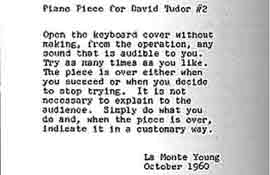
 Minimalism and Event Scores KOSTELANETZ - What happened in the piece where you burned a violin? YOUNG - That was in a piece by Richard Maxfield performed at the Y.M.H.A. in New York. Even though it was Richard's piece, he gave me free rein, as he did in all his pieces; and this one of the general conditions I often asked for my performance of the works of other composers and artists during that period. The piece was his Concert Suite from Dromenon, I believe. It involved a small orchestra, most of whom had far more rigid instructions than I did. I had my violin and my music stand, and I had carefully stuffed the violin with matches and lighter fluid ahead of time. I didn't tell anybody but Richard, who I thought should know, because I felt certain that they would not allow me to do it. Fortunately, they did not stop the performance; the instruments were playing, while the violin went blazing away. KOSTELANETZ - Was this a theatre piece? YOUNG - Both theatre and music. The definition of theatre can be expanded in much the same way we expanded the definition of music, and in many cases the two areas overlap. KOSTELANETZ - Do you consider yourself the author of the visual element? YOUNG - In this piece, yes. Particularly so, perhaps, because I was performing an aspect of my Composition 1960 No. 2, which calls for a performer to build a fire where the audience can see it. Here the emphasis was displaced from the fire along to the violin as combustible fuel for the fire. 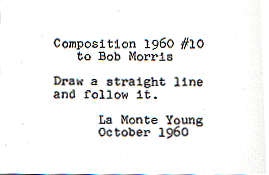
KOSTELANETZ - Where does the piece in which you drew a line for an entire evening belong in your development? YOUNG - As we have observed, I have been interested in the study of a singular event, in terms of both pitch and other kinds of sensory situations. I felt that a line was one of the more sparse, singular expressions of oneness, although it is certainly not the final expression. Somebody might choose a point. However, the line was interesting because it was continuous - it existed in time. A line is a potential of existing time. In graphs and scores one designates time as one dimension. Nonetheless, the actual drawing of the line did involve time, and it did involve a singular event - "Draw a straight line and follow it." **** My "Composition 1960 No. 9" consists of a straight line on a piece of paper. It is to be performed and comes with no instructions. The night I met Jackson Mac Low we went down to my apartment and he read some of his poems for us. Later, when he was going to go home, he said he'd write out directions to get to his place so we could come and visit him sometime. He happened to pick up "Composition 1960 No. 9" and said "Can I write it here?" I said, "No, wait, that's a piece. Don't write on that." He said, "Whadaya mean a piece? That's just a line." From Selected Writings by La Monte Young and Marian Zazeela, 1969 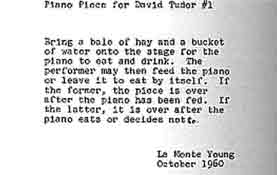
home | INTRODUCTION | PROTO-FLUXUS | CAGE | EVENT SCORES | TOKYO FLUXUS | CONTEMPORARY |